Financial Markets Are Dancing Again Blomberg
Fiscal Market Infrastructures (FMI) play a crucial role in terms of maintaining financial market function and development, thus supporting effective policy transmission and economic development financing.
Fiscal market place infrastructures (FMI) refer to all parts of the financial system that facilitate fiscal market transactions, including settlement. Co-ordinate to IOSCO, an FMI is defined every bit a multilateral organisation amid participating financial institutions, including the operator of the arrangement, used for the purposes of recording, clearing or settling payments, securities, derivatives or other fiscal transactions. Several systems are considered systemically important financial market infrastructures based on the criteria gear up by each respective state. Nevertheless, nearly definitions refer to post-trade systems.
Referring to the Principles for Fiscal Market Infrastructures (CPSS-IOSCO, 2012), FMIs are categorised as systemically important if they involve multilateral systems for the following functions: Payment Arrangement (PS), Key Securities Depositories (CSD), Securities Settlement Arrangement (SSS), Central Counterparty (CCP) and Trade Repository (TR). In its implementation, each jurisdiction has full discretion whether to consider a system a systemically important FMI. For example, New Zealand does non consider a trade repository (TR) a systemically important FMI considering it is not currently included in the regulatory framework. Bharat has designated its trading arrangement, namely the Negotiated Dealing System-Order Matching (NDS-OM) in the government securities market place, as an FMI considering it dominates 90% of transaction volume of regime securities in the secondary marketplace.
In Indonesia, the Depository financial institution Indonesia – Real Fourth dimension Gross Settlement (BI-RTGS) arrangement equally well equally the Bank Indonesia – Scripless Securities Settlement System (BI-SSSS) are categorised as systemically important FMIs, both of which are owned, operated and supervised past Bank Indonesia.
In improver, FMIs are likewise operated past self-regulatory organisations (SRO), as regulated and supervised by the financial market place authorisation. In terms of the uppercase market, the Indonesia Stock Market Immigration Business firm (KPEI) and Indonesian Central Securities Depository (KSEI) fall nether the authority of the Indonesian Financial Services Authority (OJK). Regarding, commodity futures trading, PT Kliring Berjangka Republic of indonesia (persero) and the Indonesia Clearing House (ICH) are under the jurisdiction of the Article Futures Trading Regulatory Bureau (BAPPEBTI).
To illustrate the role of FMIs, businesses require a Payment System (PS) to receive payment transactions for goods and services. The public uses a payment system to receive bacon and allowance payments. Central Securities Depositories (CSD) administrate equity and bond transactions securely and efficiently, while Central Counterparties (CCP) reduce counterparty risk past providing clearing and settlement services for over-the-counter (OTC) derivatives without going through an exchange.
Because the crucial part of FMIs in financial markets in the result of operational constraints, which could undermine the fiscal markets contribution to economic development financing and even trigger financial system instability take a chance if not well-managed, financial sector authorities effectually the globe are recognising the importance of FMI regulation and supervision.
Regulation and supervision typically involve the minimum requirements for an FMI operator and the coordination mechanism for domestic fiscal government and international authorities if the FMI is providing cantankerous-border transactions.
Fundamentally, strengthening an FMI must strike an optimal remainder between increasing financial market efficiency and development and minimising the potential risks that could disrupt fiscal system stability. Therefore, identifying the types of gamble associated with an FMI is crucial for the regime to implement the regulatory and supervisory office.
A clear and comprehensive supervisory framework based on a solid legal foundation and covering all aspects of the FMI concern is a prerequisite for constructive and efficient FMI regulation and supervision.
The regulatory approach to FMIs fundamentally relates to the legal and regulatory system governing the financial sector of a country.
In addition to prevailing laws governing the fiscal sector and relevant authorities, FMIs in Indonesia, in addition to the payment arrangement, are regulated through a segmented approach, encompassing the money market and strange exchange marketplace as well equally the capital market and commodities market place, including the derivatives market place.
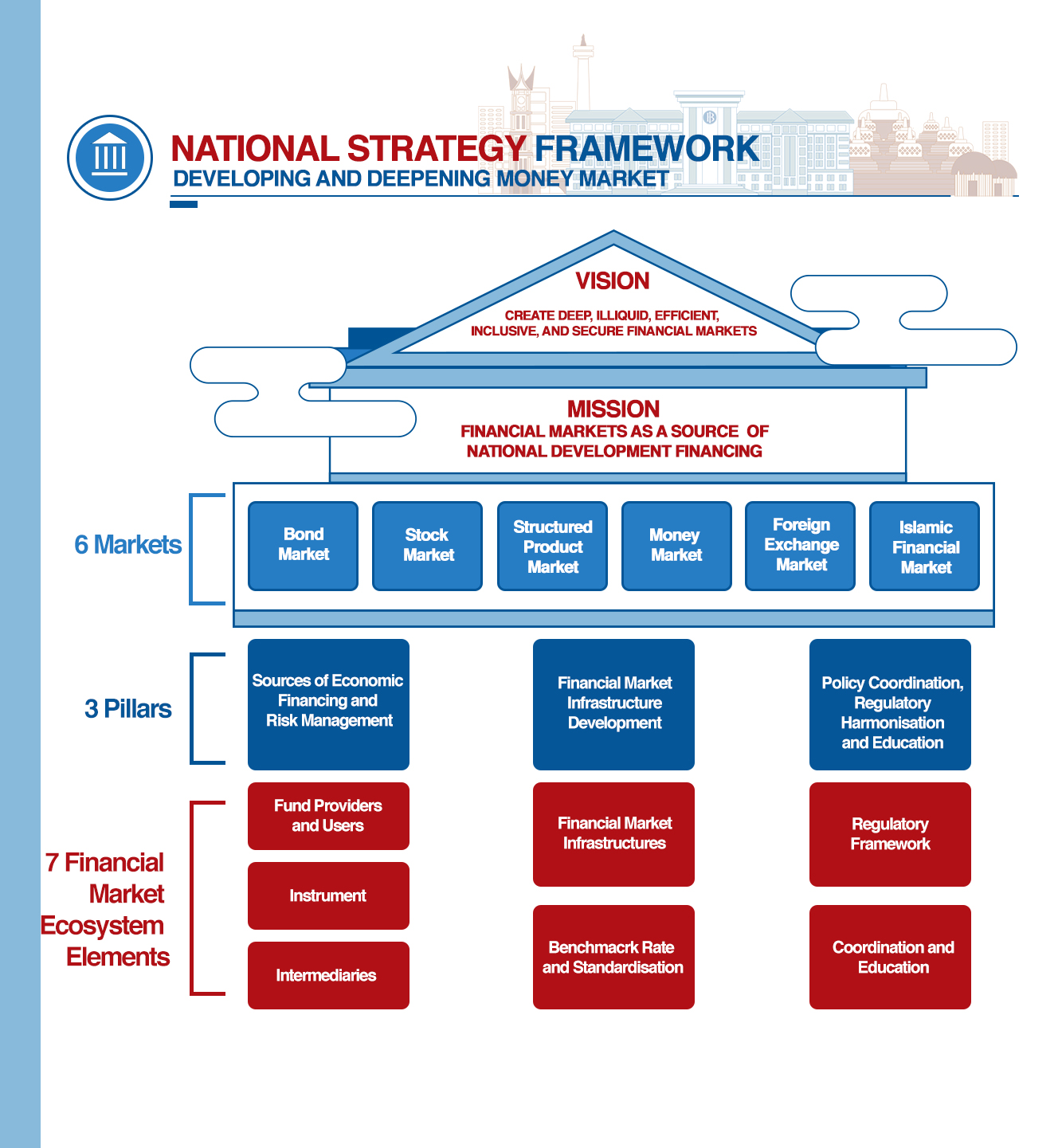
Figure:. National Financial Market Development and Deepening Strategy Framework
That approach is reflected in the fiscal market place deepening and development framework, as a joint concern of the relevant authorities, namely the Ministry of Finance, Banking concern Indonesia and Indonesian Financial Services Authority (OJK). In Indonesia, the financial market deepening and development framework is known as the National Financial Market Development and Deepening Strategy (SN-PPPK), which is a comprehensive and measured single policy framework directed towards realising the vision of deep, liquid, efficient, inclusive and secure financial markets. SN-PPPK stipulates three primary pillars underlying the development framework, namely: (i) sources of economic financing and chance management; (2) financial marketplace infrastructure development; and (iii) policy coordination, regulatory harmonisation and didactics. Financial market infrastructure development is a key pillar that is expected to support access to information as well as rapid, secure and efficient transaction settlement. To that end, inter-say-so coordination in terms of developing the FMIs under each corresponding authority is essential.
FMI evolution in Indonesia refers to best international practices adjusted to the local profile, conditions, policy preferences and national interest, which is currently considered the all-time arroyo. FMI regulation is constantly aligned with principles adopted internationally, specifically by the Committee on Payment and Settlement Systems (CPSS) and the International Organisation of Securities Commissions (IOSCO) equally independent in the Principles for Financial Market Infrastructures (PFMI) (BIS, 2012).
Guaranteeing the operational continuity of reliable, secure and efficient FMIs vis-à-vis the purview of authority and responsibilities necessitates an unambiguous regulatory and supervisory framework.
Legally mandated every bit the budgetary authorisation, Banking concern Indonesia is authorised to regulate and supervise the money market place and foreign commutation market, including those based on Islamic principles.
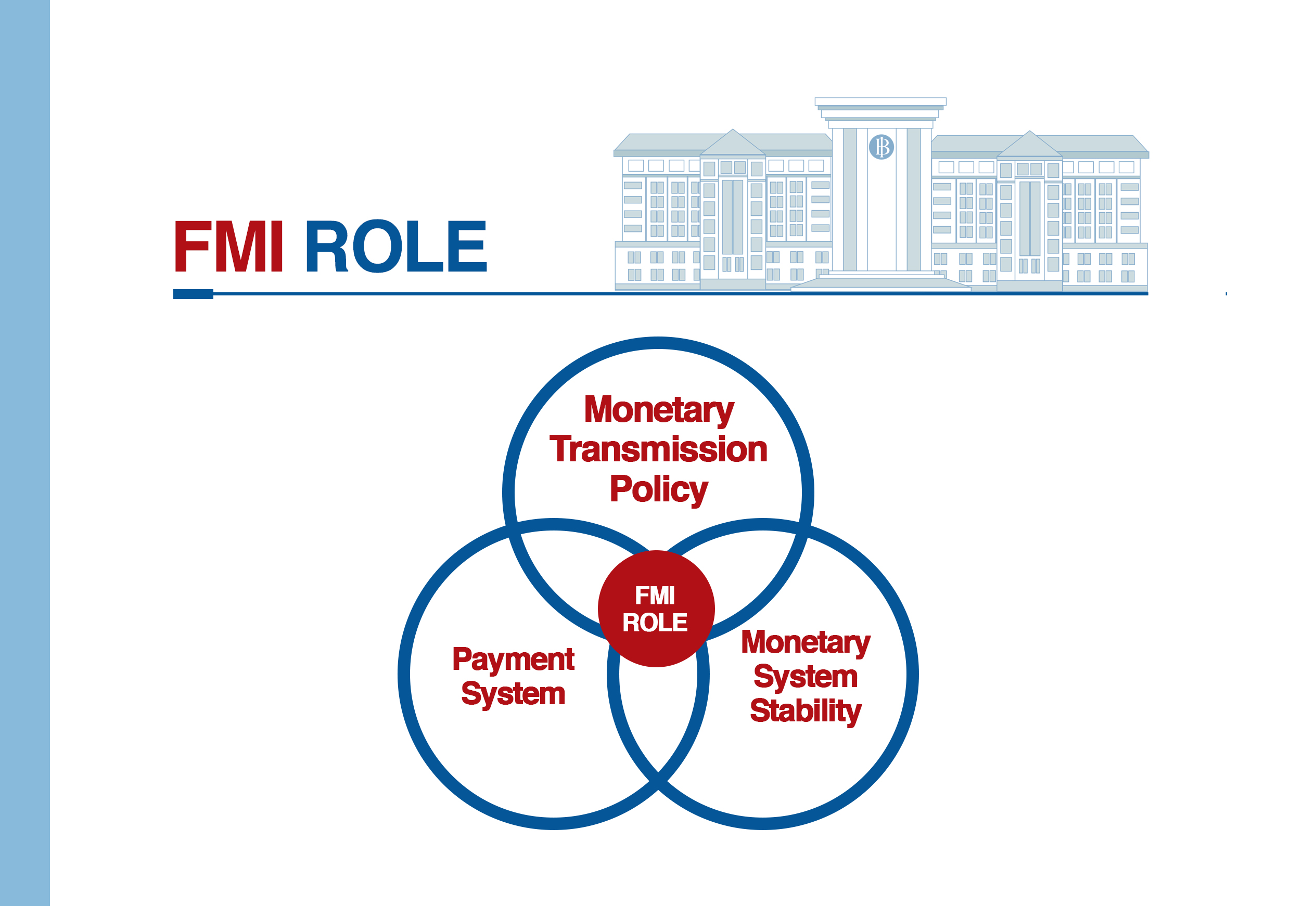
Effigy:. FMIs Play an Important Role in terms of Monetary Policy Manual, Payment Organization Function and Financial Arrangement Stability
More specifically, to strengthen Bank Republic of indonesia'southward role in the payment organization in Indonesia, Banking company Republic of indonesia released the Indonesia Payment System Blueprint (BSPI) for 2025 in 2019, which aims to support national digital economic and financial integration and, therefore, safeguard the cardinal depository financial institution functions of currency circulation, monetary policy and fiscal system stability, including financial market infrastructure development.
Every bit ane of the initiatives contained in the Indonesia Payment System Blueprint (BSPI) for 2025, fiscal market place infrastructure evolution will be achieved through infrastructure modernisation and strengthening the regulatory framework for fiscal market infrastructures in line with best practices to support optimal policy implementation. The central deliverables of this initiative include the modernisation of BI-RTGS, BI-SSSS (including the CSD part), and the Bank Republic of indonesia-Electronic Trading Platform (BI-ETP), while strengthening the regulatory framework in relation to CCP and TR development.
The lessons learned from the Global Financial Crisis in 2008 have motivated all countries to strengthen global fiscal market resilience through stronger policies and supervision in each jurisdiction, including infrastructures.
As part of the G20, FMI evolution in Indonesia has been accelerated through efforts to encounter the OTC Derivatives Market Reform mandate as a G20 initiative of the Pittsburgh Meridian in 2009. The efforts aim to increase transparency, prevent market abuse and mitigate systemic risk through five primal calendar items for OTC derivatives market reforms equally follows:
one. Standardised OTC derivatives must be transacted through Electronic Trading Platforms (ETP) or exchanges.
2. Standardised OTC derivatives must be cleared through a Central Counterparty (CCP).
3. Standardised OTC derivatives must be reported through a Trade Repository (TR).
iv. OTC derivative transactions not cleared through a CCP volition be subject to higher upper-case letter charges.
five. OTC derivative transactions non cleared through a CCP will be subject to margining rules.
Implementation of the v agenda items with a focus on derivatives transactions are expected to reinforce domestic and global financial market place resilience and, thus, mitigate similar crises, while supporting the sustainability of healthy fiscal markets. To that end, Bank Indonesia is committed with other financial government to actively support efforts to fulfil its mandate in various areas under Bank Indonesia's authorization.
There are currently two types of systemically important FMIs nether the regulation and supervision of Banking company Indonesia in accordance with Depository financial institution Republic of indonesia Regulation (PBI) No. 19/14/PBI/2017 apropos Transaction Processing, Securities Assistants and Existent-Time Settlement every bit follows:
- Banking concern Republic of indonesia – Real Time Gross Settlement (BI-RTGS) system, namely an electronic funds transfer system that allows for the instantaneous (real-time) transfer and settlement of individual transactions (Payment Arrangement function).
- Banking company Indonesia – Scripless Securities Settlement System (BI-SSSS), namely infrastructure used to administrate transactions and securities electronically (Central Securities Depositories and Securities Settlement Organisation).
Referring to the mandate for OTC Derivatives Market Reforms, as well as to implement the Indonesia Payment System Blueprint (BSPI) for 2025, Bank Indonesia is currently developing a Trading Venue & Key Counterparty for OTC interest charge per unit and exchange rate derivatives (CCP SBNT) as well as a Trade Repository as follows:
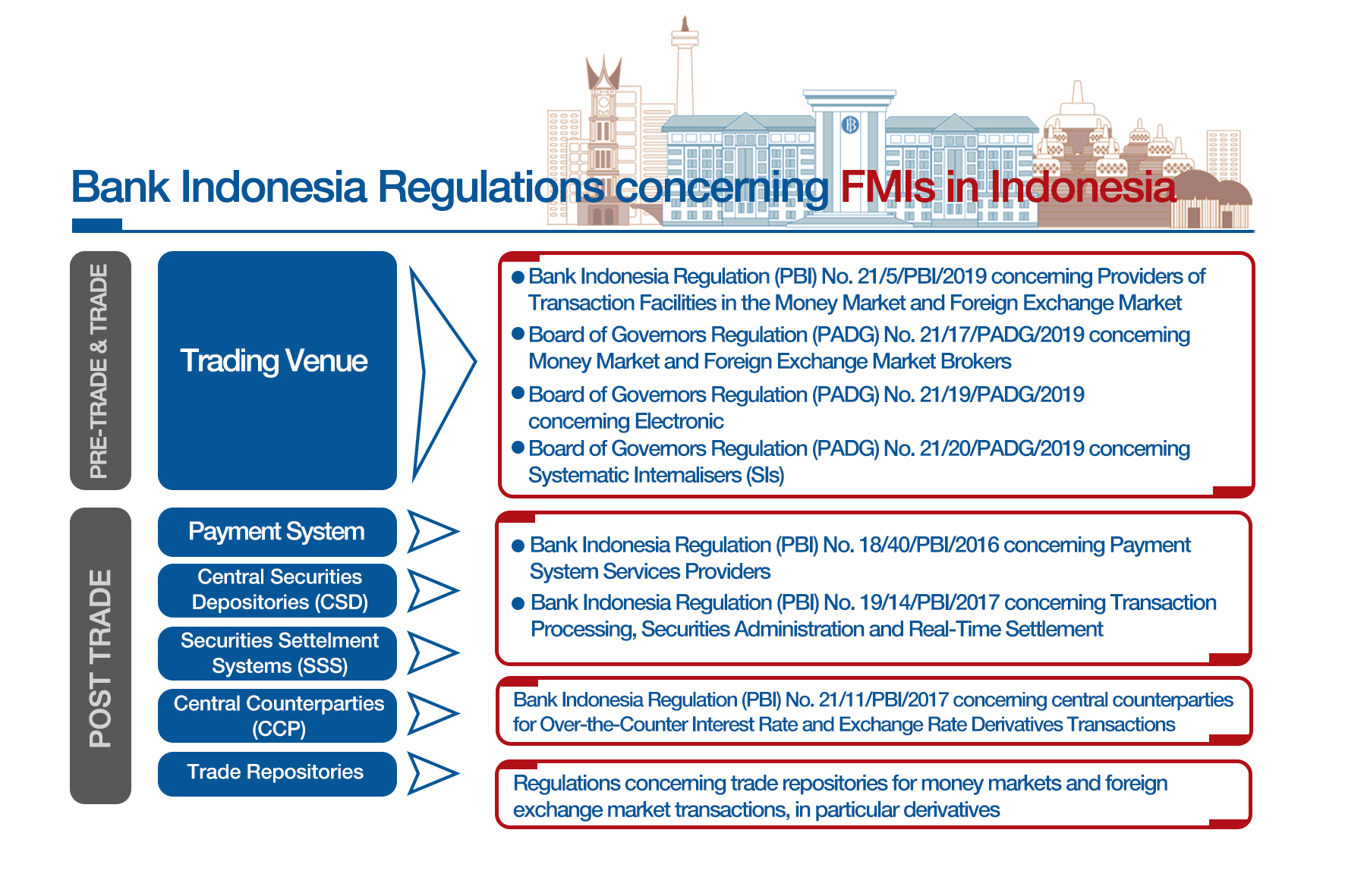
Figure: Bank Indonesia Regulations concerning FMIs in Indonesia
Moving forward, Bank Indonesia is firmly committed to financial market infrastructure evolution to support deep, liquid, efficient, inclusive and secure domestic fiscal markets that meets international best practices and standards.
Source: https://www.bi.go.id/en/fungsi-utama/sistem-pembayaran/infrastruktur-pasar-keuangan/default.aspx
0 Response to "Financial Markets Are Dancing Again Blomberg"
Post a Comment